Best AI Resume Builders in 2026: Tested and Compared
Five AI resume tools, five different jobs. A straight comparison of what each one is actually built for, including where ours is the wrong choice.

"Best AI resume builder" is a question with no single answer, because the tools in this category are not really competing. One is a design studio, one is a diagnostic, one is a job-search CRM, and one is a tailoring engine. Picking the wrong category is why people churn through three subscriptions and conclude that AI resume tools do not work.
This comparison sorts them by the job they are built for. We make one of these tools, so read the FitMyCV section with the appropriate scepticism. We have tried to be specific about where it is the wrong choice.
The quick answer
| Tool | Built for | Pick it when |
|---|---|---|
| FitMyCV | Tailoring a CV and cover letter from a job link | You apply often and tailoring is the step you keep skipping |
| Jobscan | Scoring a CV against a job description | You want a diagnostic and a match percentage, not a rewrite |
| Teal | Tracking a whole job search | You are running a long search across many roles and need a pipeline |
| Kickresume | Designing a CV from scratch | You have no CV yet and want a polished template quickly |
| Resume Worded | Line-by-line writing feedback | Your CV parses fine but the bullets are weak |
FitMyCV: tailoring from a job link
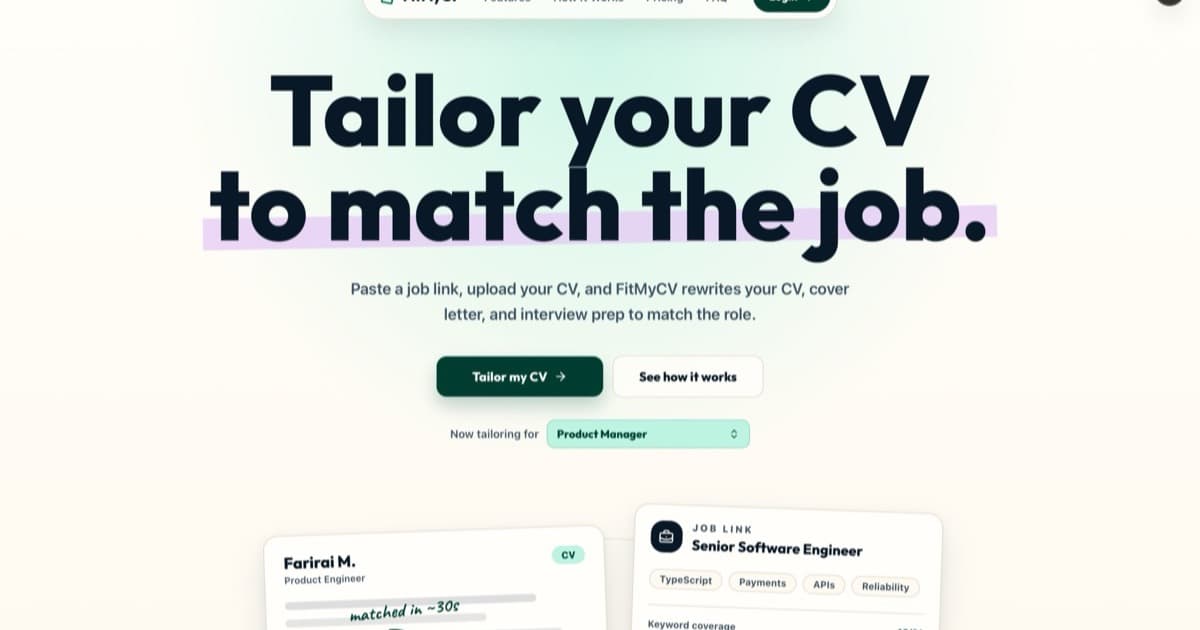
FitMyCV is built around one specific bottleneck: producing a genuinely tailored CV for each application without spending forty minutes per role. You upload your CV once, then paste the URL of the posting. It reads the listing, extracts the requirements and vocabulary, and rewrites your summary, bullet order, and wording against them, plus a matching cover letter from the same posting.
What it does well
- The input is a link, not a pasted wall of text. LinkedIn, Indeed, Glassdoor, and company career pages are read directly, which removes the copy-paste step that makes tailoring feel like work.
- CV and cover letter come from the same parse, so the two documents agree with each other and reference the same specifics from the posting.
- Output is a clean single-column PDF built to survive parsing rather than to win a design award.
- It edits rather than invents: your employers, dates, and achievements are preserved; what changes is emphasis and vocabulary.
Where it is the wrong choice
- You have no CV yet. It tailors an existing CV; it is not a from-scratch builder. Start with a template elsewhere, then come back.
- You want heavy visual design. Templates are deliberately conservative and ATS-first. If you want a portfolio-grade layout, this is not it.
- You want a job-search CRM. There is application tracking, but it is not the depth of a dedicated pipeline tool.
- You apply to two roles a month. At that volume you can tailor by hand and the tool is solving a problem you do not have.
Jobscan: the match-score diagnostic
Jobscan is the tool most people mean when they say "ATS checker". You paste your CV and a job description and it returns a match rate plus a list of hard and soft skills the posting mentions that your CV does not.
What it does well
- The clearest diagnosis in the category. It is very good at telling you precisely which terms are missing.
- Useful formatting and parse warnings that catch layout problems before you send.
- It teaches you the underlying skill. After a dozen scans you start spotting gaps yourself.
Where it falls short
- It diagnoses; it does not fix. You still write the rewrite, which is the part that takes the time.
- Chasing the match percentage encourages keyword stuffing if you are not careful.
- Free scans are limited, so per-application use means a subscription.
Teal: the job-search hub
Teal is closer to a CRM for your job search than a resume tool. It tracks roles you are interested in through stages, stores versions of your CV, and layers AI assistance on top.
What it does well
- Genuinely good pipeline tracking: saved roles, stages, follow-up reminders, notes per company.
- A generous free tier for the tracking side.
- Multiple CV versions in one place, which suits people applying across two or three different role types.
Where it falls short
- It is a lot of tool if all you want is a tailored CV. There is real setup before you get value.
- The best AI features sit behind the paid tier.
- Tracking only helps if you maintain it; abandoned pipelines are worse than no pipeline.
Kickresume: design-first building
Kickresume is the strongest option if you are starting from a blank page. A large template library, an AI writer that drafts sections from a job title, and a genuinely pleasant editor.
What it does well
- Best-looking output in the category by a clear margin.
- Fastest zero-to-CV path: a plausible draft in about fifteen minutes for a first CV.
- Good for career changers who need structural suggestions, not just wording.
Where it falls short
- Some of the most attractive templates are two-column with sidebars, which is exactly what scrambles on extraction. Choose a single-column template and run the copy-paste test.
- AI-generated starting content is generic by definition. You must replace it with your own numbers.
- Per-application tailoring is manual, so the ongoing work stays with you.
Resume Worded: writing feedback
Resume Worded scores your CV on writing quality rather than keyword match: weak verbs, missing quantification, filler, bullet length. It also has a well-known set of free tools that made it the default recommendation in a lot of career subreddits.
What it does well
- Best line-level writing feedback. It is specific about which bullets are vague and why.
- Strong at pushing you to quantify, which is the single highest-leverage CV edit.
- Useful free tools for a first pass.
Where it falls short
- Feedback is largely role-generic rather than tied to the specific posting you are applying to.
- Like Jobscan, it tells you what is wrong and leaves the rewriting to you.
- Overlaps heavily with a builder if you already have one.
Side by side
| FitMyCV | Jobscan | Teal | Kickresume | Resume Worded | |
|---|---|---|---|---|---|
| Builds a CV from scratch | No | No | Partly | Yes | No |
| Rewrites against a specific posting | Yes | No | Partly | No | No |
| Reads a job URL directly | Yes | No | Yes | No | No |
| Match / ATS score | Yes | Yes | Partly | No | Partly |
| Cover letter from the same posting | Yes | No | Yes | Yes | No |
| Application tracking | Basic | No | Yes | No | No |
| Design-led templates | No | No | No | Yes | No |
| Writing-quality feedback | Partly | No | Partly | Partly | Yes |
How to choose in one minute
- 1No CV at all? Kickresume, single-column template, then run the parse test.
- 2CV exists but gets no responses? Jobscan or Resume Worded first. Find out whether the problem is parsing, keywords, or weak writing.
- 3CV is fine but you cannot sustain tailoring? A link-based tailoring tool. That is the gap FitMyCV was built for.
- 4Long search across many roles? Teal for the pipeline, plus one of the above for the documents.
Whichever you pick, the fundamentals do not change: single column, standard headings, the posting's vocabulary, and a number in every bullet. The ATS-friendly resume guide covers those in full, the free ATS checker comparison sorts diagnostic tools, the AI tailoring tools comparison is the sibling for job-link rewrites, and the tailoring walkthrough covers the manual method if you would rather not pay for anything at all.
Want to see the tailoring approach?
Paste the link to a job you are applying for and see what a CV rewritten against that specific posting looks like.