How to Tailor a CV From a Master Resume
Write everything down once. For each job, copy the relevant parts, reorder them, and rewrite the top in the posting's language. Never invent.

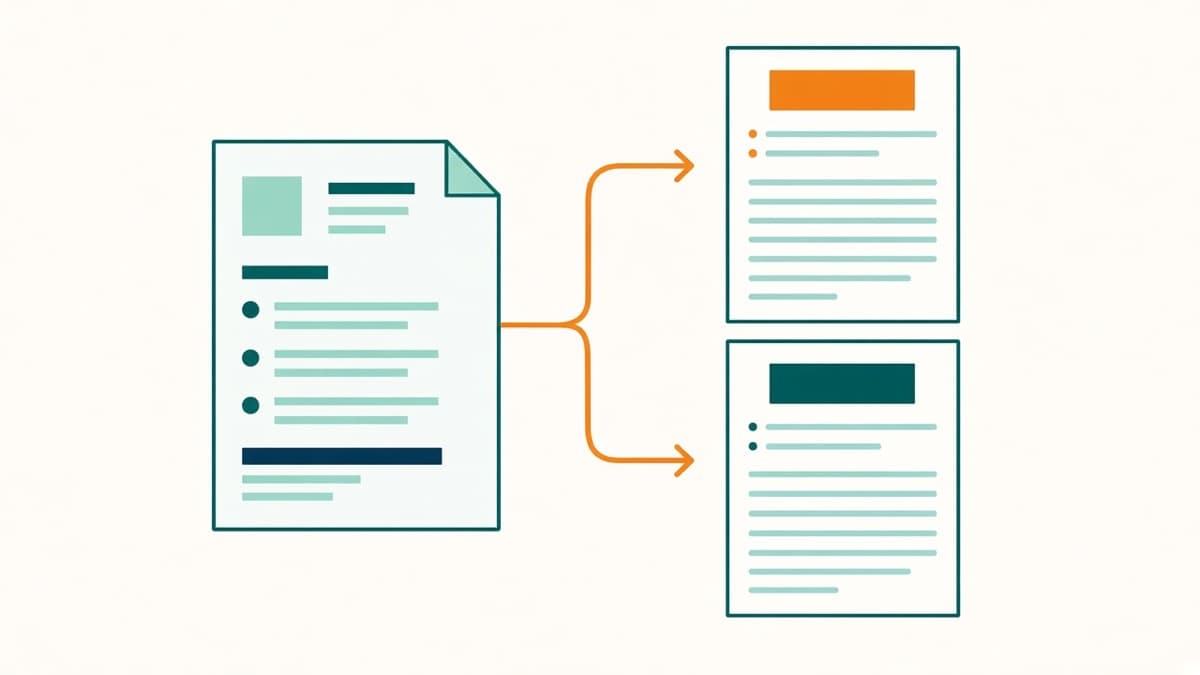
Keep one long master resume with everything in it. For each job, copy only the parts that job needs, reorder them, and rewrite the summary and top bullets in the posting's language. Never add anything that is not already in the master. That is the whole method.
People on Reddit ask the same question every week: how do you tailor your resume for each job without rewriting it from scratch every time? The answer is to stop treating your CV as one document. Treat it as two. A master that only you read, and a short tailored CV that you send.
Why a master resume works
Most people keep one CV and edit it in place for each job. After a few rounds, they have deleted good bullets they now need, and they cannot remember which version said what. A master fixes that. Nothing ever gets deleted from it. You only delete from the copy.
It also makes tailoring a cutting job rather than a writing job. Cutting is faster and safer. You are choosing from things you already wrote when you had time to get the facts right, instead of inventing phrasing under pressure at 11pm before a deadline.
What goes in a master resume
Put in everything you would ever want on a CV. Write it once, properly. Here is the structure to use.
- Contact details and links. Name, email, phone, city, LinkedIn, portfolio or GitHub if relevant.
- Three to five summary drafts. One for each kind of role you apply to. You will rewrite the chosen one each time, but starting from a draft is faster.
- Every role you have held. Employer, title, dates, location. These never change between versions.
- Every bullet for each role. Aim for eight to fifteen per recent role. Include the ones you think are boring. A future posting may want exactly that.
- Metrics with their source. Write the number and a note on where it came from, so you can defend it. Keep the note out of the tailored CV.
- A full skills list, grouped. Tools, methods, languages, certifications. Mark each one you could use on day one.
- Projects, volunteering and side work. Anything with a result you can describe.
- Education and qualifications. With dates and any coursework that matters for some roles.
- Alternate wordings. If you did the same work under two names (for example, customer success and account management), note both terms beside the bullet.
How to tailor your CV from the master
Read the posting and list what it repeats
Copy the job description. Note the skills, tools and duties that appear more than once or sit under required. Those are the terms that matter. A free tool like the keyword checker pulls them out for you.
Duplicate the master into a new file
Name it after the company and role. Never edit the master itself during tailoring.
Delete what this job does not need
Go role by role. Keep three to six bullets for recent roles and one to three for older ones. Cut skills the posting does not care about. This is the biggest step and it should feel ruthless.
Reorder what is left
Put the bullet that best matches the top requirement first in each role. Move the matching skills to the front of the skills list.
Rewrite the summary and the top bullets
Use the posting's words where they describe what you actually did. If they say stakeholder management and your bullet says worked with other teams, change it. If they name a tool you have never used, do not.
Check for gaps
Run the tailored CV and the posting through the resume job match checker. Any required term still missing is either a real gap or something you forgot to put in the master.
A worked example
This is an invented example to show the method. Meet Thandi, a sample candidate with six years in operations at a logistics firm and a retail chain. Her master resume runs to four pages. Her most recent role has fourteen bullets.
She finds a posting for an Operations Analyst at a software company. The posting repeats three things: SQL reporting, process improvement, and working with product and engineering teams. It mentions Python once, as a nice to have. She has never used Python.
From her fourteen bullets, she keeps five. She cuts the ones about warehouse staffing, fleet scheduling and supplier negotiations. They are good bullets. They are just not for this job. They stay in the master for the next logistics role.
The master version is accurate but uses her old employer's language. The tailored version uses the posting's terms for the same work.
Built weekly reports on delivery times for the regional manager using data pulled from the dispatch database.
Built weekly SQL reports on delivery performance for regional leadership, used to set targets across 12 depots.
The 12 depots figure was already in her master, with a note on where it came from. She did not add it during tailoring. She also wrote SQL because her master notes the dispatch database queries were written in SQL. The word was true, just missing.
Her master summary draft for analyst roles, then the version she sent.
Operations professional with six years of experience in logistics and retail, skilled in reporting and team coordination.
Operations analyst with six years of SQL reporting and process improvement in logistics and retail. Works closely with product and engineering teams to turn data into changes on the ground.
Python stays off the CV. She has not used it, so it does not appear. If the gap matters to her, she can mention in the cover letter that she is learning it, if that is true. For help with the summary itself, the professional summary generator gives you a draft to edit.
What to cut, and what never changes
| Item | In the tailored CV? | Why |
|---|---|---|
| Bullets unrelated to the posting | Cut | They push relevant work lower on the page. |
| Skills the posting ignores | Cut or move to the end | The top of the skills list is what gets read. |
| Older roles | Keep the entry, cut to one to three bullets | Dates must stay continuous, detail does not. |
| Duplicate bullets that prove the same thing | Keep the strongest one | Two bullets saying one thing look like padding. |
| Employers, titles, dates | Never change | That is the record, not the pitch. |
| Metrics | Copy exactly from the master | Rounding up during tailoring is how numbers stop being true. |
If you are not sure how far to go, the rule from how much to tailor your resume holds: change the top third, and leave the rest of the record alone.
Check a tailored CV against the posting
Paste your CV and the job description. See which required terms are covered and which are missing. Free, no sign-in, and your CV is not uploaded.
How long tailoring should take
Building the master takes an evening or two. Pull every old CV, performance review and project note you have, and write it all down. Do not edit for length.
After that, plan on 15 to 20 minutes per application. Most of that time is reading the posting and deleting. If it takes longer, your master probably has weak bullets that need rewriting every time. Fix them once in the master instead. The resume bullet rewriter and the weak words checker help with that pass.
If 20 minutes per job is still too slow for the number of jobs you apply to, that is the point where a tool earns its keep. More on that below.
Common mistakes
- Editing the master during tailoring. You will lose bullets. Always work on a copy.
- Keeping too much. A tailored CV with every bullet from the master is not tailored. Two pages is a ceiling for most people, one is fine for early careers.
- Inventing to fill a gap. If the posting wants something you do not have, leave it out. Adding it is not tailoring.
- Forgetting to update the master. When you finish a project or get a new number, add it to the master that week. Otherwise you will be digging for it later.
- Stuffing keywords. Use the posting's terms where they fit naturally. A CV that repeats one phrase six times reads badly to the person who decides.
Doing it with a tool instead
The master resume method is free and it works. The cost is time. If you want to do it with zero spend from start to finish, read how to tailor your resume for free for a full workflow using free tools and ChatGPT's free tier.
FitMyCV does the same job from a job link. You upload your CV once, which works best if you upload your long master. Then you paste a job link or the job description, and you get a tailored CV and a cover letter you can download as a PDF. It only works from what is in your CV, so the master rule still applies: keep it complete and true.
Free accounts can tailor and see a preview: the full summary, the first line of each role, and the first paragraph of the cover letter. The full document needs a paid plan, which is $9.99 a month or $29.99 lifetime. If you want to compare doing this in a chat window instead, see FitMyCV vs ChatGPT, and for the manual method in full, the step by step tailoring guide.
Tailor your master CV from a job link
Upload your master resume once. Paste a job link and get a tailored CV and cover letter built only from what you wrote.